Friday, September 25

The world outside - sights on the first road trip since lockdown was lifted.

The lockdowns due to the pandemic severely curtailed any travel. An e-pass could be obtained for only three reasons - the wedding of a close relative which had been planned, the funeral of a close relative and for medical treatment.
Despite these provisions and obtaining an e-pass my husband could not be there for the funeral of his mother, in mid April. Nor could he participate in the ceremonies which are performed in the following months.  
Five months of travel restrictions have been eased and we can now travel out of the district and return if we have any government issued proof of residence in the district.
Our first road trip post lockdown was to spend a few day with my father in law and  my husband's family.    
It was interesting to see the changes post lockdown. Checkposts are in place to check papers and take swabs for testing.   
Small businesses are limping back to life. I stopped at this stone carvers shop at the side of the road to buy a stone motar and pestle and then as pure indulgence I bought a small grinding stone, a must have in all kitchens in India but have become a rarity since the electric mixer grinder came onto the market.  
So many sizes to choose from and they are all hand made.
I got out of the car to take a picture of this charming display of masks for sale on the highway. so very  creative. Masks have come to stay. Part of the new normal.   
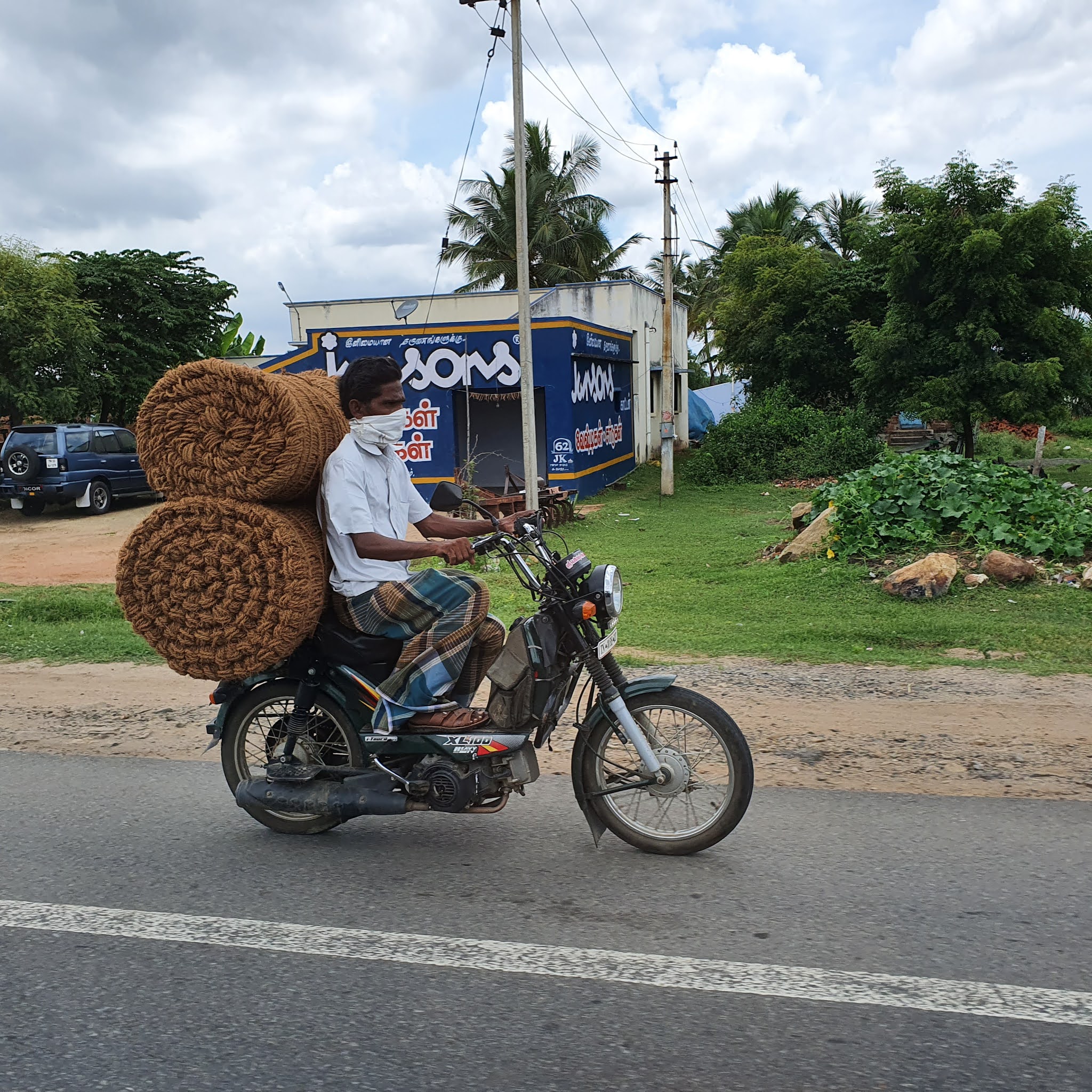
A man with bundles of rope made from coir - coconut fiber. Cottage industries  which require one or two people and physical distancing can be maintained have been functioning I think. 
The slow life is also the way forward.
This was an astonishing sight on the highway. A large boat being hauled on a truck. Wonder where it was being taken.
A boy on a cycle selling packets of cotton candy. A bizarre sight on a highway but he's probably going from one village to another selling the cotton candy. People are being forced to buy local and forgotten recipes are being unearthed and local produce is being used. Using what is in season, an appreciation for home cooked food, cooked from scratch.                                             
In the cities and along the highway many restaurants have shut shop. We did see these pop up restaurants. Food is cooked and served and when they are sold out, everything gets packed into their pick up and they head home.
We too packed sandwiches for the trip and ate our lunch under a tree by the side of the highway. On the way back my sister in law made lime rice and coconut rice for lunch. Reminded us of roadtrips in our childhood where mothers cooked and packed food and snacks for the trip. The picnic basket was the most important, it couldn't be forgotten.
Food for a picnic or a roadtrip is going to be my next project.                                                 
A motorised peacock chariot used in great fat Indian weddings. The bridegroom arrives in style. Traditionally the bridegroom would ride a horse and a procession of dancing relatives with a band playing would make their way to the bride's house. The horse has given way to a jazzed up motorised peacock chariot which would not have had much use in the past six months. 
Weddings in India were always big and fat. The guest list ran to a few hundreds, all that has changed overnight. You can't have more than 30 guests and everybody gets a Youtube link to watch the happy occassion live.  I think big fat Indian weddings are a thing of the past.   
Trucks and commercial vehicles usually have some sort of social message painted on the bumper. A decade or two back it was We Two,  Ours Two - a reminder to people to have small families, all in an attempt to control the exploding population. Then there was Save Rain Water, Don't Drink and Drive, even female infanticide - Save Daughters, Educate Daughters and now on the bumper of a milk tanker was spotted - Wear Mask, Stay Safe. 
Only in India. Livestock being transported on a bike and in a small pick up truck.

Ayyanar shrines. Fearsome in appearance, these larger than life deities found in a small grove of trees on the outskirts of a village are meant to protect the village.  Covid 19 is a whole other ball game I guess.  

We were driving through the countryside and farming is the main occupation. It's interesting to see what is grown locally. We passed many trucks loaded up with bananas.   
Custard apples are in season. we stopped to buy from a woman who had a basket of fruit. Unlike bananas which are grown commercially, custard apple and peanuts are grown for peoples own consumption, anything extra is sold on the highway. Cart with locally grown fruit. Figs, Carambola or Star Fruit and Custard Apple. 
The pandemic has changed the world.

What is the new normal -

Masks are here to stay. I have a mask in every bag and in the glove compartment of the car. 

You don't need much and you already have all you really need. I didn't have to buy much during the lockdown and nothing was missed. Was always one who enjoyed window shopping. 

Buying local and buying what is in season. There's a time and a season for everything and I'm trying to see what time is the best time to do something during the year, for example I now know if I want to make pickles and jams, it will have to be in April and May. june is a good time to separate lily bulbs and replant them. The poinsettia begins to bloom in August.
    
Practising thrift in the use of resources - I have come across so many recipes which utilise every part of a fruit or vegetable or make use of leftovers in a creative manner. 
There's a huge interest in mending. Do check out Mend - A Refashioning Manual and Manifesto

Becoming more self reliant. Working with your hands, learning new skills. I need to create content for courses to be taught online. Huge shift from teaching a group of people who are in the same space.

Adopting a slow life. 

Adapt or perish. 

What changes do yo see in your life due to the Covid pandemic and post lockdown? 

Wednesday, September 2

The Cocoon - Work in Progress

It's been a few months since I updated this space. 
A lot has happened but I simply haven't had the time to update Million Little Stitches. These days my instagram account @millionlittlestitches gets updated instantly with all that's happening on the creative front.
The Cocoon, a kimonoish robe is influenced by my environment.
The mist, rainfall, the vegetation and the little creatures which abound.
Rain. Life giving and keeps the place so lush and green. Brings leeches too.
The gauzy mist, which transforms the landscape into a mysterious place.
Berries on a tree in the Shola. Looks tempting but I'm not sure if they are edible.
Clover growing between the granite paving.
Brilliant colour contrast. The wet grey granite and the green Clover. 
The brilliant colours on a month's wings which I found one morning. The patterns will find their way onto the robe, to embellish it.
The front of the kimonoish robe. The white bedsheet foundation is completely appliqued with pieces of fabric.
The back. It's interesting to note that the white sheet has become the lining for the robe.
A patchwork of colours and textures, much like the environment.
Now to begin embellishing the Cocoon.

Restrictions on movement of people and interactions have eased considerably although people are fearful of the Coronavirus rearing its head suddenly.
Life has changed. The new normal is still evolving but masks are here to stay.
The internet is the lifeline which keeps families and loved ones in constant touch , it's the source of entertainment,  the marketplace to buy and sell, to get an education.
How are you adjusting to the new normal?
I shall be back very quickly to keep this channel alive because it's been one platform which has kept me in touch with the wider world, living as I am in a small town in wondrous isolation, most of the time.


Tuesday, June 30

The Cocoon


The Cocoon will emerge from a torn bedsheet. A cotton sheet made soft and with use and washing for more than a decade.
The idea to repurpose the sheet as a kimonoish robe came from Spirit Cloth - Jude Hill's blog as well as the Instagram account @ragmates2020 where like minded people are showcasing their work.
I'm no dressmaker so the kimonoish robe is the result of research on Pinterest.
The king size sheet allowed me to get the kimono as a single piece garment.
I couldn't wait to attach a couple of patches.
A rust dyed patch was the first addition. I attached it to the base fabric with my interpretation of sashiko. The second patch was from an experiment with bleach. I did blanket stitch around the bleached out splotches.
There is no plan as far as placement of patches, it's just whatever strikes me at the moment. So while planning the next patches I decided the sleeves ought to be symmetrical. The rest of the robe will be asymmetrical. That's the plan at the moment.
Started attaching other bits of fabric. The patches overlap and I do running stitch, almost like darning through the patches and the base fabric.

This project of The Cocoon really ties in well with my effort to adopt more sustainable living practises. To reduce the consumption of resources, and see the potential of reusing and recycling things and materials which I already possess.
I'll be looking at Kantha, Japanese boro and Sashiko for inspiration. I want to embellish the Cocoon with things in my environment -  the flora and fauna. I hope I can capture the balance and harmony of the natural world which surrounds me and constantly inspires and leaves we wondering and delighted.


Friday, June 26

Jams, Pickles and Chutneys

These days my interactions with the world happens on Instagram.
It's here that I get inspired and learn a thing or two. It's also the place where I get to participate in projects.

'The plan is to create a printed/stitched fabric quilt that explores your individual experiences, thoughts & emotions collectively about your time in
Your contribution will be made into an amazing quilt, which will showcase beautifully your individual response to the global pandemic.' - Sue Brown.

There was the choice of making a collagraph plate and sending it across to Sue to be printed and then embellished with embroidery or to make one that's the same size - 10 cm × 10 cm but embroidered.
I went for the embroidered option.
The pandemic had me in the kitchen re evaluating what we cook. It's an opportunity to use locally grown seasonal produce - fruit and vegetables in my cooking not that I've been one to scour the pantries online for exotic ingredients. To learn to preserve and buy sufficient ingredients and use them judiciously and creatively.
I made jams, pickles and chutneys during the two month long lockdown. Strawberries were going cheap because they couldn't be transported to the cities. I made two batches in fact. My first attempt at jam making and the results were encouraging.
Then I made plum jam which reminded me of boarding school and the jams which were on the table for breakfast- plum jam, marmalade which I never liked and bilberry jam. Made from seasonal fruit which were grown locally.
It was a bonus if we got a plum seed when we took a spoonful of jam. We would suck on the seed and ultimately crack it open and eat the white kernel inside.

When the lockdown coincided with the start of the mango season  I decided to make Chundo - a sweet and savoury mango pickle which matures in the hot summer sun. It's a no cook pickle which I love and I had all the ingredients as well as two months of intense sunlight, the most important ingredient for making  Chundo the slow old fashioned way. Brings back memories of my years at design school. Lime pickle and green chilly pickle were made and shared with friends.
As for chutneys I was looking for recipes which use parts of fruits and vegetables  like the skin to make chutneys and other accompaniments in a meal.
One chutney was with the  white portion of  the watermelon rind. The other chutney to try is with the peel of the ridge gourd.
A number of these recipes which lay forgotten are being rediscovered during these uncertain times where people are being forced to be frugal.

My contribution to Same Sea, Different Boat. The finished piece with bottles of jams and pickles.
Left to right - Plum jam, Strawberry jam and Chundo. In front is the small round bottle of green chilly pickle.
Now to mail this piece to Sue in the UK.
I hope the postal service has begun to function, last time I checked it was only medicines which could be posted. Keeping my fingers crossed.

I hope all of you are safe and well.
The numbers of infected people are on the verge of exploding I think in India.
Health services are overwhelmed in certain cities. Not long before communities are infected because people are moving from infected areas to districts where the infection was low. Totally irresponsible and selfish.
What a year it's been.

Friday, June 12

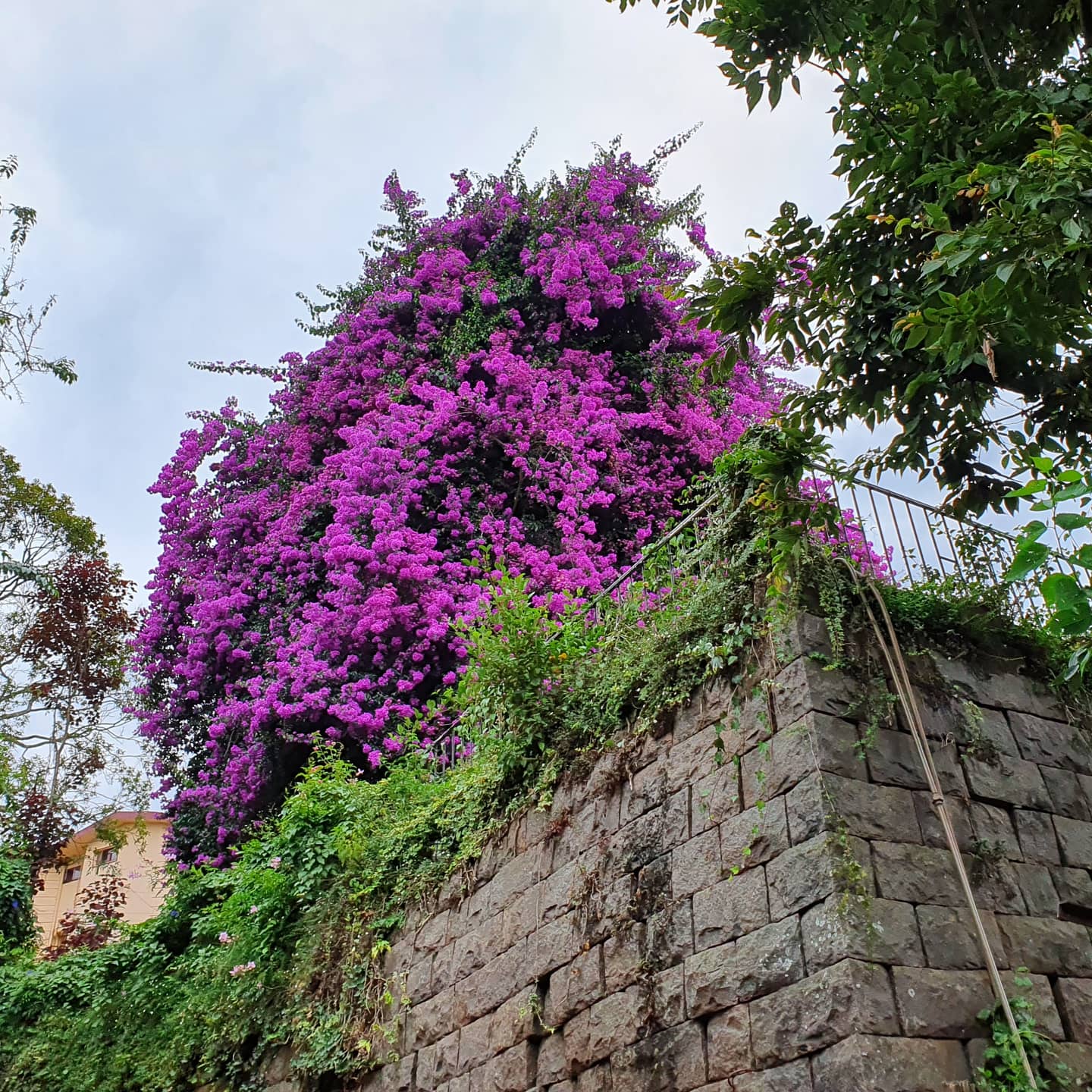
Spotting Purple Bougainvillea

There's a particular purple bougainvillea which you see only around Coonoor.
The colour is intense, and in summer - April and May it blooms and it's one mass of purple blooms with no leaves visible.
Unlikemost other bougainvillea this particular one grows large and thick becoming a tree.
This young plant promises to grow into a major show stopper.


This is what I meant when I said it grows into a tree.
This particular bouganivillea plant at a firend's place must be a couple of decades old.
I've got myself some cuttings.
In the meantime I'll continue to spot Purple bougainvillea around town.

Tuesday, May 26

#The100dayproject

#the100dayproject began on the 7th of April this year.

I've decided to create 100 collages. 4" × 6" collages, upcycling materials found in my home, between the pages of my journal or from my surroundings. Quotes, poems and general words of wisdom. 
So why not celebrate them and make them a set of 100 cards which one can pick at random and feel inspired when one reads a quote and find reassurance in the words of a poem. At some point I did consider 100 Covid19 jokes.  

I've become a hoarder of all sorts of scraps and bits. Bills, moth wings, beer bottle tops, envelopes, plastic casing of tablets and the twine used to tie a package. everything has potential.


Here are the first five of hundred.

1/100 - Diwali sweet box base, poem - Finding Courage, Blanket stitch.


2/100 - Moonsoon Harvest muesli carton, quote - Robin Wall Kimmerer, faggoting with embroidery thread done to hold the pieces of the card together.
Cutting the pieces of the muesli carton so that they fit was an exercise in balance.
Must find ways to give back. 
3/100 - envelope to which strips of paper from a Tupperware flyer were woven and stuck.Further embellished with cross-stitch done with embroidery thread. Quote, hand written on brown paper from an envelope.
    

4/100 - Teacher's 50 whisky carton, brown paper envelope, Ferrero Rocher foil, handwritten bit of wisdom.
Have to learn to focus better and stop getting involved in too many projects. Oh! But there are so many interesting ones.
5/100 - Citibank flyer for the blue base, Scottish leader whisky carton, cotton twine which was used to tie a package for the embroidered quote and embroidery thread for blanket stitch along the edge.
Need to set the benchmark high.

100 cards in a 100 days is not going to happen. It's going to take longer than that. 
The coming together of the base card, the quote, poem or recipe and the ephemera takes time but at times it all happens in a day. 
It's going to be a 100 cards following a slow process but the 100 collages shall be made.

How are you doing in your corner of the world?
Hope you and your families are well and safe.

Sunday, May 17

The Birthday Present - a commission

A prayer for a best friend's 40th birthday and I was asked to interpret it as an embroidered piece.
I was introduced to Michael Leunig. An Australian cartoonist, writer, painter, poet and philosopher.
One of my favourites is Bunker.  Absolutely delightful little characters and a reccuring motif is the teapot, probably why the the cartoons appeal to me even more.

     
Found this font trawling the internet and felt it resembles Leunig's style

From my stash of fabric swatches I chose indigo,blues, blue greens and some shibori because the recipient loves the sea and on a strip of muslin I cross stitched a wave pattern in blue thread.  

A variation of darning used to join the strips of fabric together. In the lower right hand corner I embroidered what I think of as coral. Growing slowly.

This is the finished piece.Wonky edges, a slow cloth. A piece to invoke contemplation. 
I'm contemplating a tragedy unfolding in the country.
These are troubling times,uneasy times. 
An uncertain future for millions across India. 
Millions of migrant workers make their way on foot criss-crossing the country to reach home. Pregnant women,young children and men carrying all they own on their heads making their way home in the summer heat which is at 40 degrees centigrade now across most of the country. 
They have not been paid their wages and have no access to food or drinking water. 
Everyday there are more horror stories to be heard.  
Empty promises. Talk is cheap.
Government assistance to transport migrant labour back to their home towns has come too late. 
This crisis over shadows the pandemic. It's a lethal combination. 
It's a cry not just a prayer - God help us to live! 
Millions are contemplating - emptiness.
What will the heart create for us? 
A revolution me thinks.    

Saturday, May 9

21 Kusudamas for the 21 day lockdown


With the announcement of the 21 day lockdown in late March, I set myself a personal challenge, to use the time to learn to fold and create 21 origami kusudamas.
The Kusudama or medicine ball is believed to have originated in the Heaian Period (794 -1192).
Fragrant woods and herbs were put into a small cloth bag, decorated with blossoms of sobu, iris and other flowers, long silk threads of five different colours were attached to the bag.On May 5th this bag was hung in the house to ward off evil spirits and disease.  
The Emperor at the time would invite officials to Butokuden palace and give each one of them drinks of sake and a kusudama, this custom continued until the beginning of the 17th century. 
Going forward the connection of the kusudama with court functions ceased to be and instead became an ornament in the homes of the common people and a plaything for children.

Sorry about the spacing, can't rectify it. 
 I didn't know at the time that I would commit myself to a few more challenges so instead of completing 21 kusudamas in 21 days,it took me a good month and a half.
The process was meditative because of the repeated folding of modules for each kusudama. Some required as few as six modules whereas most required thirty or more.Especially the larger ones. I used old Tupperware flyers with their colourful pages to cut squares for the origami.     

This one is an exciting one, a transformer. It's called the Revealing Flower or Pop Up Star. Designed by Valentina Gonchar  and I followed this tutorial to make it.
There's more than one reason why you should use contrasting colours for the outside modules and for the revealed flower modules - first reason impact. Kind of lost in the one I've made, shall rectify that and make another one with contrasting colours and a tad smaller.
The second reason is that you won't go and mess up while assembling the modules.A lot of time wasted in reassembeling! Totally unnecessary.   

This one is called Electra. Designed by David Mitchell and here is the video tutorial if you would like to try your hand at making one. The tutorial is in Portuguese but it doesn't matter if you don't understand the language because the folding of the modules is clearly demonstrated.      
This delicate and pretty kusudama made with just six modules is called a Traditional Kusudama the tutorial can be found here.

This Kusudama is my favourite. The tutorial and all other information was in Russian so I don't know the designer or name of the kusudama. Unfortunately I didn't save the link to the tutorial. 

 Nine kusudamas, these are larger. Twelve in the picture below. A total of 21 kusudamas.


 These are smaller and require anywhere from six to twelve modules.
Some kusudamas can be created with twelve modules and increasing the number of the same modules to thirty gives you a kusudama with a whole different form.
I'm going to give these kusudamas to friends to hang in their homes or verandahs and hopefully there will be healing of the world at large and in their homes.I'm also going to leave them for people to find.
Here are the links to some of the other kusudamas which I made
1. Top left corner - The Kusudama Spiky Ball Star - uses just 6 modules. No need for glue. Makes a great Christmas decoration as well.  
2. Top right corner -  Origami Kusudama Little Turtle - requires 30 modules.
3. Bottom left corner - Origami Kusudama Star - requires 30 modules.
4. Bottom right corner - Crystal Star Kusudama - designed by Denver Lawson. Requires 30 modules  
I was surprised to discover a Coronavirus Kusudama as well. It requires 30 pieces of paper 1:4 proportion. Does not use square pieces of paper. I tried it but the paper I had was too flimsy.

I find origami like embroidery a meditative process. A slow process, requires precision and the results are rewarding.
I can watch my movies on Netflix and fold modules for a kusudama or do a bit of mending for #mendmay2020.
Have you got involved in any creative challenge during this period of social distancing and isolation?  Hope you are well and safe. 

ShareThis