Showing posts with label Hampi. Show all posts

Tuesday, May 15

April CQJP

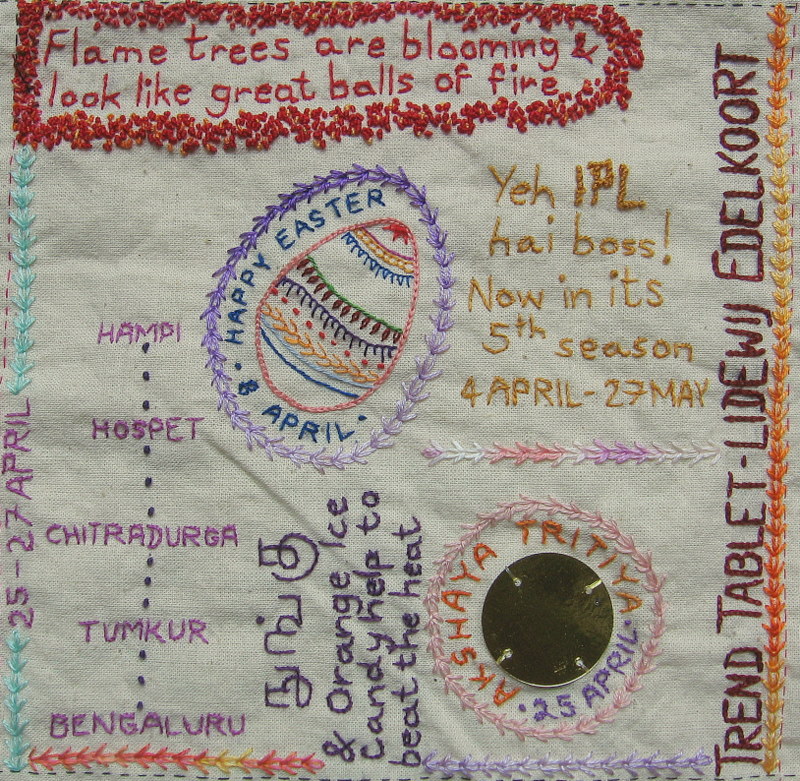
The Crazy Quilt block for April is a celebration of Summer.The use of orange is because of  The Flame trees/Gulmohar's which burst into bloom in April and the orange ice candy from Nandini which fills the freezer compartment of my fridge.  I decided to use a crochet sample which I found in a bag of scraps and incorporate some figurative embroidery with the windmills of Chitradurga. 
The Crazy Quilt block and the accompanying journal page.

IPL has us in front of the television watching cricket. In April we finally made the journey to Hampi and were impressed. We can't stop telling our friends to go and stop postponing. I finally got to use one of the big gold sequins to represent a gold coin for Akshaya Tritiya.    
We've devoured seasonal fruit like the nungu, and watermelon to beat  the heat. Have you eaten Nungu? its the fruit of the palmyra palm.and nungu is the word embroidered in the Tamil script.

Thank you everybody who voted for Origami on the Reader's Choice Top Five on Feeling Stitchy. It was close and as the seconds ticked by  it was a nail biting finish. Final count -  Narwhal with a tattoo scroll 82 and Origami 79. Read more about it here.  

Tuesday, May 8

Hampi


The amazing rocky landscape in around Hampi. 
Coconut palms, mango trees and banana plantations thrive in between rocky outcrops. 


The rocks are the building materials for the beautiful monuments and structures that dot the landscape.
A line of evenly spaced holes on a rock is evidence of a simple but effective method employed to cleave enormous boulders and rocks. The holes were plugged with wooden pegs and water poured in. When the temperatures fell in the night the pegs expanded and over time the rock split. 
Rough hewn rocks to build high walls and gateways. 
    Cut with precision these rocks have been used to make this beautiful stepped water tank or pushkarni which was discovered as late as 1984 and had no stone missing.
The building blocks for the creation of monuments like the Lotus Mahal above and the Queens bath below.    

A stone picture book .The outer walls of the Hazara Rama temple brought the story of the Ramayana to life for the devotee as he circumambulated the temple.  
The stone chariot at the Vithala temple complex. The chariot is a shrine for Garuda - Vishnu's vahana and the wheels rotate.

The Vitthala temple.
In the Mukha mandapa are a series of slender stone pillars which when struck with the bare hand in a particular manner will produce the sound of a musical instrument - one set of pillars produces the sound of drums another the sound of bells. The temple has exquisite carvings.  
  
Stone also became the medium for recording the activites which were a part of daily life many centuries back such as the trading in jewels, gold and horses. In a frieze on the plinth of the Vitthala temple are carved Portuguese and Chinese traders with horses.
Hampi must have been a vibrant and spectacular place in its heyday. Today we have the temples and monuments made and carved out of rock to piece together what life was like in the Vijayanagar Empire.  

On a different note I have a favour to ask. Once again I need you to vote for my suggestion which has made it to the Reader's Choice Top 5 on Feeling Stitchy.
My suggestion for the Reader's Choice Stitchalong next month is Origami. The poll is at the top right hand corner of the blog - Feeling Stitchy. Please vote for Origami. Thank you. Polling is open until Wednesday evening, 10PM US Central time.
  

Sunday, April 29

The Elephants at Hampi

R and I decided to drive 400kms to visit Hampi in Bellary district which was the capital of the Vijayanagara Empire and is a place of religious, mythological and cultural importance as well as being listed as a Unesco World Heritage site.Its the height of summer and temperatures are close to 40C but we like to visit places when its off season and there are less people around.  
I'm going to do a couple of posts on our trip to Hampi but I'm going to start with the elephants which were accorded great importance then as they are now and are depicted on so many of the monuments.   
At the Virupaksha Temple we bought bananas to feed the temple elephant but we ended up feeding the cows instead because the elephant had gone down to the river to bathe.
The plinth of the Mahanavami Dibba has depictions of elephants in various moods. The sculptors were keen observers of the form of the elephants and their moods. I wonder how they recorded their observations.No 16th century sketch books lying around. 
A procession of elephants in the Hazara Rama temple.
The Elephant Stables.
Elephants were mainly used for battle but there were eleven special elephants which were used during the Dussehra festival and had their own stable and keepers who had their quarters close at hand near the Zenana Enclosure.I haven't heard of this much importance accorded to elephants in any of the other dynasties which flourished in India.  
Must go back to Hampi to record the elephant in all its various moods which are depicted on all the monuments. That would probably require a life time or more because the excavations continue in Hampi.  

ShareThis